
Waterloo in 22 minutes, £4.00 off-peak, six to eight trains an hour. Every borough station compared: Barnes is faster than Richmond and £468 a year cheaper.
Richmond upon Thames is unusual among London boroughs in that it straddles four zones. A commuter in Barnes and a commuter in Hampton pay the same council tax to the same council, and one of them pays £1,164 a year more to get to work. This page sets out the times, the zones and the fares from every station in the borough, checked against Transport for London’s own fare and journey data.
Richmond station: three railways from one entrance
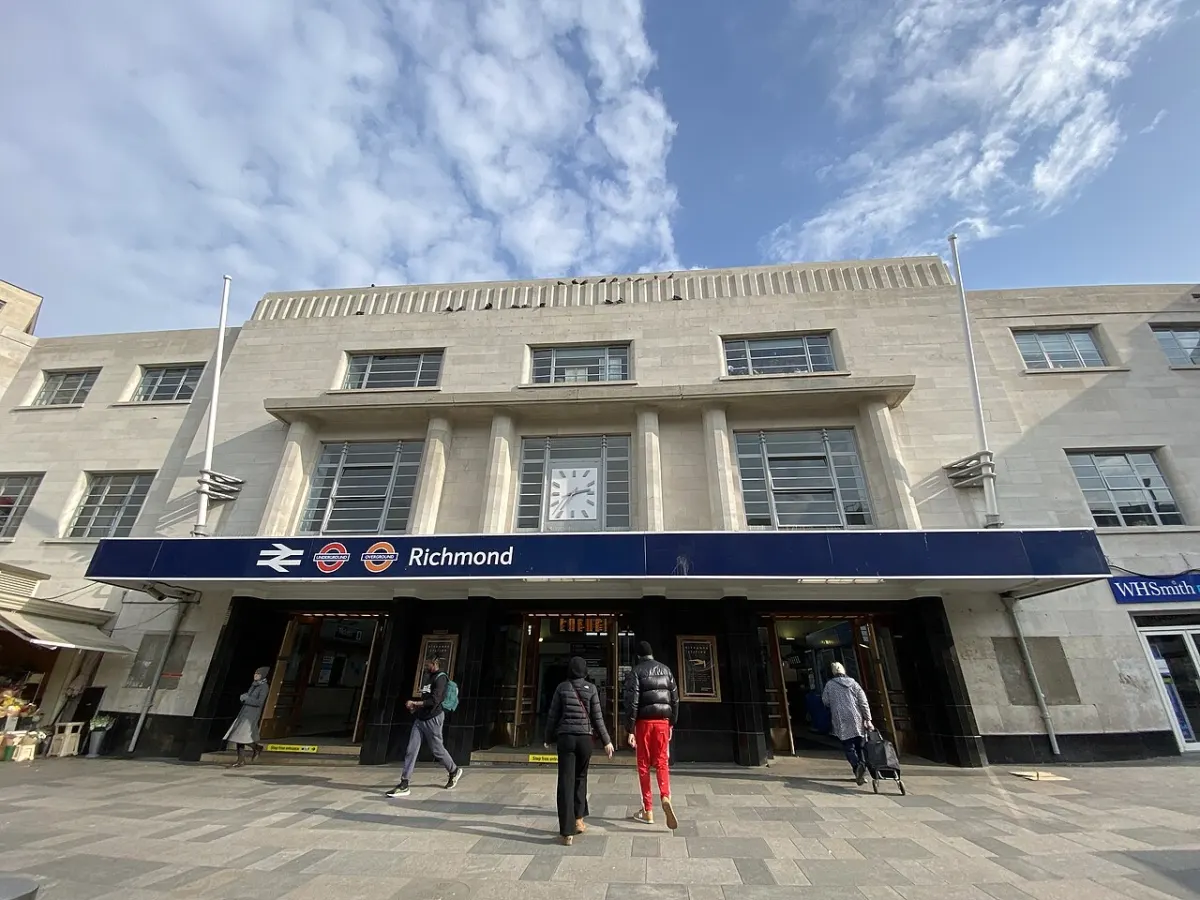
Richmond is the borough’s main interchange and it is served by three operators from the same building on Kew Road:
- South Western Railway to London Waterloo, the fast route. The quickest morning trains do it in 22 minutes.
- The District line, which runs all the way into central London via Hammersmith, Earl’s Court, Victoria and Westminster. Richmond gets six District trains an hour, every hour, seven days a week.
- The Mildmay line on the London Overground, which runs east across north London to Stratford via Willesden Junction, Hampstead Heath and Highbury and Islington.
Richmond is in zone 4. A pay-as-you-go single to Waterloo is £4.00 off-peak and £5.30 at peak times.
The District line is worth knowing about for two reasons. It is cheaper: a pay-as-you-go single from Richmond to Waterloo Underground station is £3.60 off-peak against £4.00 on the train. It is also much slower: TfL’s own journey planner puts the District line run at around 40 minutes to Waterloo against 22 by South Western Railway. If you are going to Victoria, Westminster or South Kensington the District wins outright, because there is no change. For anything at Waterloo, Bank or the City, take the main line.
Richmond to London Waterloo: how often, and how long it really takes
Twenty-two minutes is the number everyone quotes, and it is real, but it is the fast train rather than the average one. We counted every South Western Railway service from Richmond to Waterloo across a normal Wednesday using Transport for London’s own journey data, and the spread is wider than the headline suggests.
| Hour | Trains to Waterloo | Journey times |
|---|---|---|
| 08:00 to 08:59 | 8 | 21 to 29 minutes |
| 12:00 to 12:59 | 6 | 20 to 27 minutes |
| 17:00 to 17:59 | 7 | 20 to 29 minutes |
Six to eight trains an hour, all day. In the morning peak they leave at 08:01, 08:08, 08:15, 08:24, 08:28, 08:34, 08:45 and 08:49, so you are rarely waiting more than about ten minutes. Off-peak the gaps are longer and lumpier: midday runs 12:15, 12:19, 12:28, then nothing until 12:45.
The same route takes 19 to 30 minutes depending which train you board. The fast services run 20 to 22 minutes; the stopping ones, which call at Barnes, Mortlake and North Sheen, take 27 to 30. Two trains four minutes apart can arrive at Waterloo eight minutes apart, which matters far more to a commuter than the timetable’s headline figure. If the board offers you a 27 minute train and there is a 22 minute one seven minutes behind it, the later train wins.
First and last. The first train leaves Richmond at 05:14 and reaches Waterloo at 05:42. The last leaves at 00:15 and gets in at 00:34, and at 19 minutes it is the fastest run of the day, because there is nothing else on the line to slow it down. There is no service in the small hours: the gap between 00:15 and 05:14 is the one to plan around, and it is why the District line, which also stops overnight, is not a fallback either.
Departure times and durations counted from the TfL journey API for a standard Wednesday, checked 27 August 2026, against the May 2026 timetable. South Western Railway’s autumn timetable took over on 20 September 2026 and pulls most departures one to five minutes earlier, so treat the minute figures above as the shape of the service rather than the exact clock times; the pattern of six to eight trains an hour and the 05:14 first train are unchanged. Engineering work rewrites weekends, so check before you travel.
The Richmond to London Waterloo timetable changed on 20 September 2026
South Western Railway moved to its autumn timetable on Sunday 20 September 2026, and it runs until Saturday 12 December 2026. The company’s own description of the change is that there are “minor changes to train times, with services departing between one and five minutes earlier compared to our May 2026 timetable” (SWR timetables).
Richmond sits on Timetable 9, Twickenham and Richmond to London Waterloo, which is the booklet to download if you want the printed times rather than an app: Timetable 9 from 20 September covers Whitton, Twickenham, St Margarets, Richmond, North Sheen, Mortlake and every station in to Waterloo. The first weekday departure from Richmond is unchanged at 05:14.
A minute or two off a departure sounds like nothing, and for most journeys it is. It matters in one case: if you have built your morning around catching a particular train with two minutes to spare, that train now leaves before you get there. Check your own departure once rather than assume the pattern held.
Wandsworth Town is being skipped on Monday middays until 11 October
The new timetable booklet carries a notice about step-free access work at Wandsworth Town, one stop before Clapham Junction on this line. Until Sunday 11 October 2026, trains towards Clapham Junction will not call at Wandsworth Town between 11:00 and 14:00 on Mondays only. Every other time of day and every other day of the week runs as printed. If Wandsworth Town is your stop, that is a three hour window each Monday when you need to go on to Clapham Junction and come back, or start from Putney.
Every borough station, compared
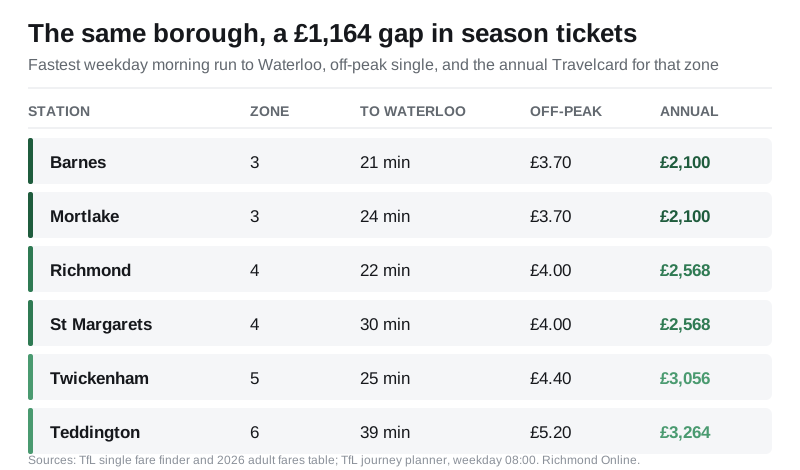
The counter-intuitive result is that Barnes, at 21 minutes, is the fastest station in the borough to Waterloo, and the cheapest. It sits in zone 3, with a short run through Putney and Clapham Junction and no reason to stop much. Richmond, with far more trains and three railways, is a minute behind it and £468 a year more expensive on an annual Travelcard.
At the other end, Teddington is 39 minutes and zone 6. It is not distance that does it: Teddington is barely three miles from Richmond. It is that Teddington sits on the Kingston loop, where trains call at everything, and that the zone boundary puts it in the most expensive band.
Full pay-as-you-go singles to London Waterloo, from the TfL single fare finder, for fares in force from 4 July 2026:
| Station | Zone | Off-peak | Peak |
|---|---|---|---|
| Barnes | 3 | £3.70 | £4.60 |
| Barnes Bridge | 3 | £3.70 | £4.60 |
| Mortlake | 3 | £3.70 | £4.60 |
| Richmond | 4 | £4.00 | £5.30 |
| St Margarets | 4 | £4.00 | £5.30 |
| Twickenham | 5 | £4.40 | £6.60 |
| Teddington | 6 | £5.20 | £8.50 |
| Hampton | 6 | £5.20 | £8.50 |
| Hampton Wick | 6 | £5.20 | £8.50 |
Kew Gardens is the odd one out. It has no South Western Railway service at all, only the District line and the Mildmay line, and it straddles the zone 3 and zone 4 boundary. A pay-as-you-go single from Kew Gardens to Waterloo Underground station is £3.30 off-peak and £3.90 at peak, which makes it the cheapest single into central London from anywhere in the borough.
Caps, Travelcards and what a season really costs
Nobody in this borough should be buying a paper season ticket without first checking the daily and weekly caps, because contactless and Oyster pay-as-you-go cap automatically. These are the 2026 adult rates from TfL:
| Zones | Daily cap | 7 day | Monthly | Annual |
|---|---|---|---|---|
| 1 to 3 (Barnes, Mortlake, Kew Gardens) | £10.50 | £52.50 | £201.60 | £2,100 |
| 1 to 4 (Richmond, St Margarets) | £12.80 | £64.20 | £246.60 | £2,568 |
| 1 to 5 (Twickenham) | £15.30 | £76.40 | £293.40 | £3,056 |
| 1 to 6 (Teddington, Hampton, Hampton Wick) | £16.30 | £81.60 | £313.40 | £3,264 |
Two things fall out of this table. First, the £1,164 spread between a zones 1 to 3 annual Travelcard and a zones 1 to 6 one, for journeys that differ by about six miles. Second, the daily cap does most of the work for anyone not commuting five days a week: at £12.80, a Richmond resident going into town for the day and moving around central London pays the cap and nothing more, whatever the tube map does.
If you only travel within the borough and never cross into zone 1, the cheaper outer-zone bands apply and the numbers change completely. Zones 4 to 6, for example, is £37.10 for seven days against £81.60 for zones 1 to 6.
Match days at Twickenham
Twickenham station serves Allianz Stadium on Whitton Road, and on international match days it is the busiest station in the borough by a wide margin. If you live in Twickenham, St Margarets, Strawberry Hill or Whitton and you are travelling for anything other than the rugby, the dates to plan around for the rest of 2026 are Saturday 26 September (Red Roses v New Zealand), Sunday 8 November (England v Australia), Saturday 14 November (England v Japan) and Saturday 21 November (England v New Zealand), all listed on the England Rugby events page.
On non-event days the World Rugby Museum at the stadium is open Tuesday to Saturday 10am to 5pm and Sunday 11am to 5pm.
Getting to the station
Richmond, Twickenham and Teddington all have paid council car parks within walking distance, and the cheapest all-day option in Richmond is Old Deer Park at £21.10 for 24 hours, which is free to park in outside its charging hours of Monday to Saturday 8am to 6.30pm and Sunday 11am to 5pm. The details, and the trap of the Paradise Road multi-storey costing £31.60 for a stay over nine hours, are on the Richmond roadworks and travel page.
Frequently asked questions
How often do trains run from Richmond to Waterloo?
Six to eight an hour throughout the day. On a standard Wednesday there were 8 departures between 08:00 and 08:59, 6 between 12:00 and 12:59 and 7 between 17:00 and 17:59. The first train leaves Richmond at 05:14 and the last at 00:15.
How long does the train take from Richmond to London?
22 minutes to London Waterloo on the fastest South Western Railway morning trains, according to TfL’s journey planner. The District line takes around 40 minutes to Waterloo but runs direct to Victoria, Westminster and South Kensington.
Has the Richmond to Waterloo timetable changed?
Yes. South Western Railway’s autumn timetable started on 20 September 2026 and runs to 12 December 2026. Most departures move one to five minutes earlier than the May 2026 timetable. Richmond is covered by Timetable 9, Twickenham and Richmond to London Waterloo, and the first weekday train from Richmond is still 05:14.
What zone is Richmond station in?
Zone 4. Barnes, Barnes Bridge, Mortlake are zone 3, St Margarets is zone 4, Twickenham is zone 5, and Teddington, Hampton and Hampton Wick are zone 6. Kew Gardens straddles zones 3 and 4.
How much is a train from Richmond to Waterloo?
£4.00 off-peak and £5.30 at peak on pay as you go, on fares in force from 4 July 2026. Contactless and Oyster cap at £12.80 a day for zones 1 to 4.
What is the cheapest station in the borough to commute from?
Barnes, Barnes Bridge or Mortlake, all zone 3, at £3.70 off-peak and £2,100 for an annual zones 1 to 3 Travelcard. Barnes is also the fastest to Waterloo at 21 minutes.
Which stations in the borough have the Underground?
Only Richmond and Kew Gardens, both on the District line. Richmond also has the Mildmay line on the London Overground, running east to Stratford.
Is it cheaper to take the District line than the main line?
To Waterloo, yes: £3.60 off-peak by District line against £4.00 on South Western Railway. It is also roughly 18 minutes slower, so the saving is 40p for the best part of a third of an hour.
Sources
- TfL single fare finder and the TfL Unified API fares endpoint for every pay-as-you-go single quoted, all showing fares valid from 4 July 2026.
- TfL adult rate fares 2026 for daily caps, 7 day, monthly and annual Travelcard prices.
- TfL journey planner for the fastest weekday 08:00 journey times, checked station by station.
- TfL journey API for the Richmond to Waterloo departure counts, first and last trains and the spread of journey times, sampled across a standard Wednesday on 27 August 2026.
- TfL StopPoint search for the zone of every station named here.
- World Rugby Museum for stadium and museum opening hours.
Fares and times were checked against TfL’s own data in August 2026. Engineering work, strikes and match days all change what actually runs, so check before you travel.
Have your say